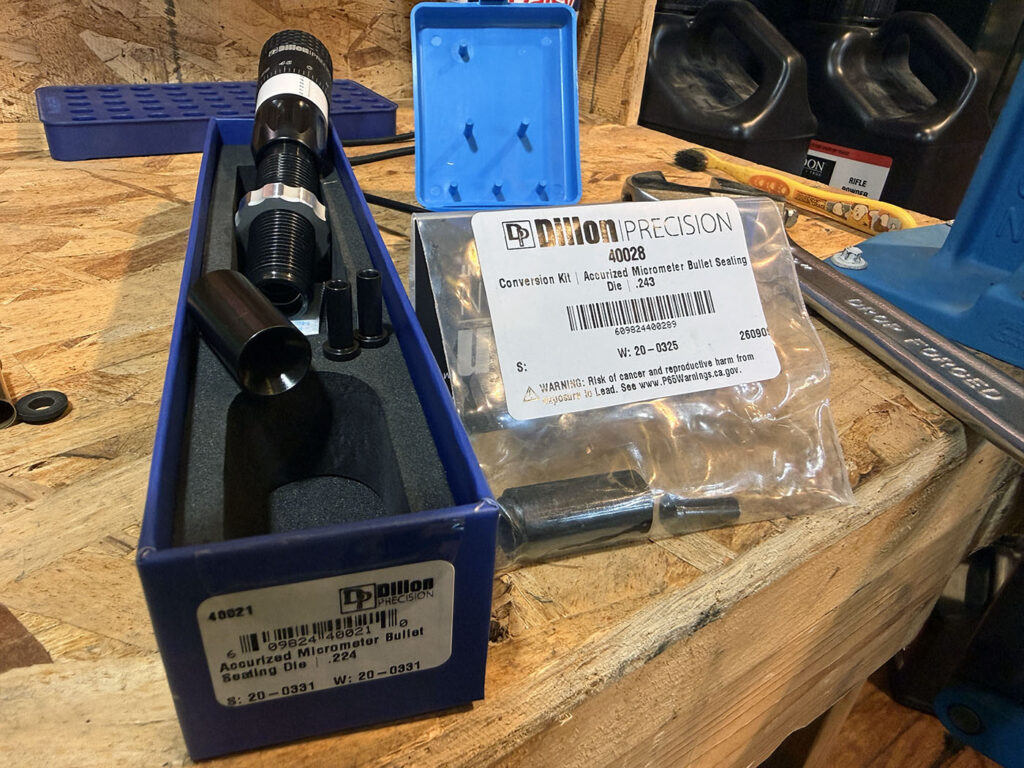
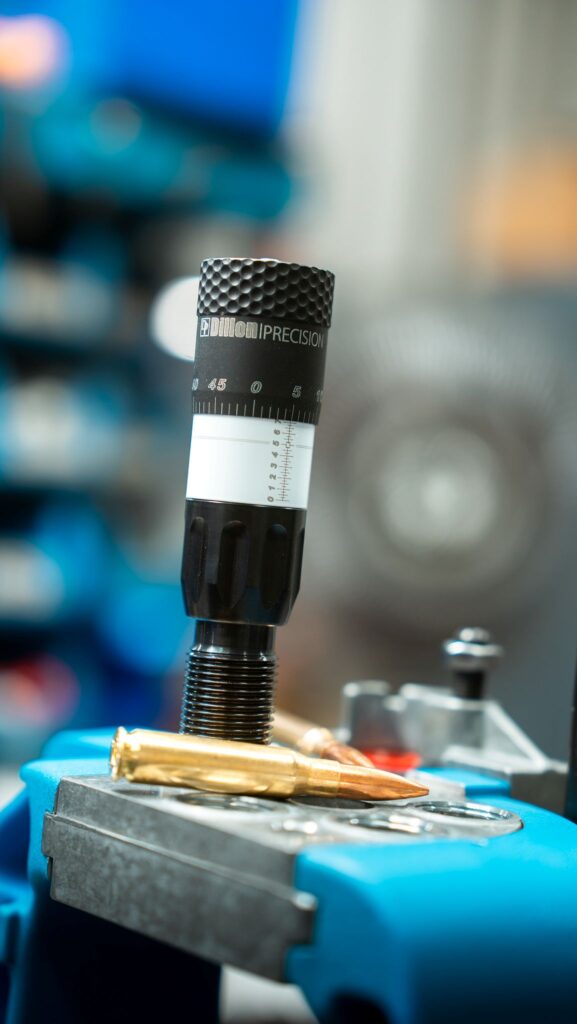
I know I shouldn’t be admitting this, but I never thought I’d need a micrometer bullet-seating die. Why? Because I grew up on the cheap. So far, I have used the threads on the seating rod to adjust my way down to the desired depth. Frankly, I always feel like this is a bit of a shot in the dark. “Let’s try this much…oh, too much.” The Dillon accurized seating die runs 325$ with the caliber setup of your choice. Each extra caliber is 50$. This may seem like a lot, but not when you figure out what you are getting. Now that I have had the opportunity to use Dillon’s new die, I am digging it. Literally, measurable ease in finding the throat for seating depth, and I am seeing the possibilities of how it makes financial sense.
I have long wanted to reload for my Mini Howa in 6mm ARC. What a fantastic little round! We have hunted several deer and Hawaiian goats with it. I put it in a Stocky’s carbon stock and mounted an ultralight 2.5-10x SWFA scope for a total of 6.25 lbs. Every ounce counts when I’m hiking the mountains in search of food and predators.
As a hunter, the Hornady 103gr ELD-X is a longer-range ballistic coefficient mix of hunting-intended construction. I was previously loading 38 Special ammunition on this Dillon model 550 and didn’t have to change the small primer seating and tube for the 6mm ARC conversion kit. Whatcha! A few bolts and set screws, I am ready to lock and load.
It always takes a little bit of time to set each die to your desired outcome, but it goes pretty quickly. I am usually a single-stage fan. Most of my ammunition is custom-fit to the gun for accuracy and the general need for longer-range performance. I live in and hunt the mountains of Montana. I rarely shoot anything at less than 200 yards. Single-stage presses are generally considered to throw more accurate loads. However, the groups I shot tonight were the best I have seen yet out of this rifle. With a Dillon press, I am excited to crank a round out with every pull of the reloading lever. It is rather tedious loading in single-stage monotony. I usually only consider progressive presses as pistol reloading options, but with the Dillons, that just isn’t so. I even reload 45-70s on these 550s.
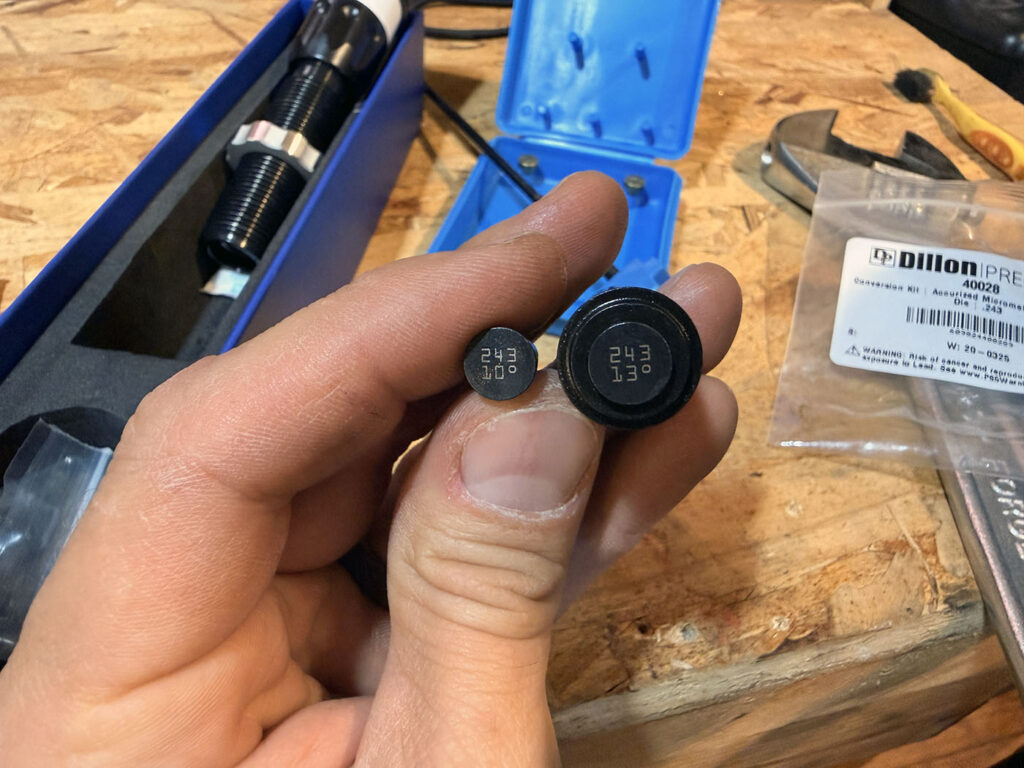
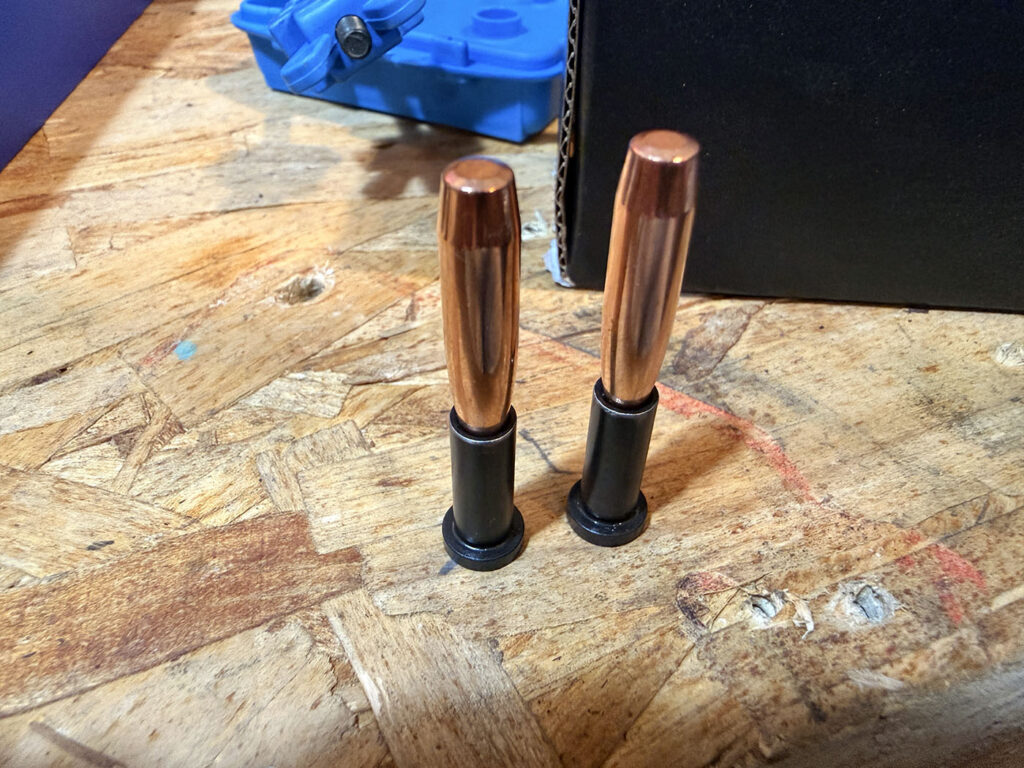
The Dillon micrometer seating die comes with two different angle seaters. They are easy to swap out and give you the option for less deformation on your bullet depending on its profile. I pulled out an individual bullet and tried the fit in both seaters and selected the 13-degree option. The die screws apart in the middle and you just put the seating die caliber conversion down in against the spring and screw it back together. The design of this die centers the cartridge off the shoulder for reliable accuracy across the different cartridge shapes. I have 5 different 6mm cartridges I load for, and they all center up in the die.
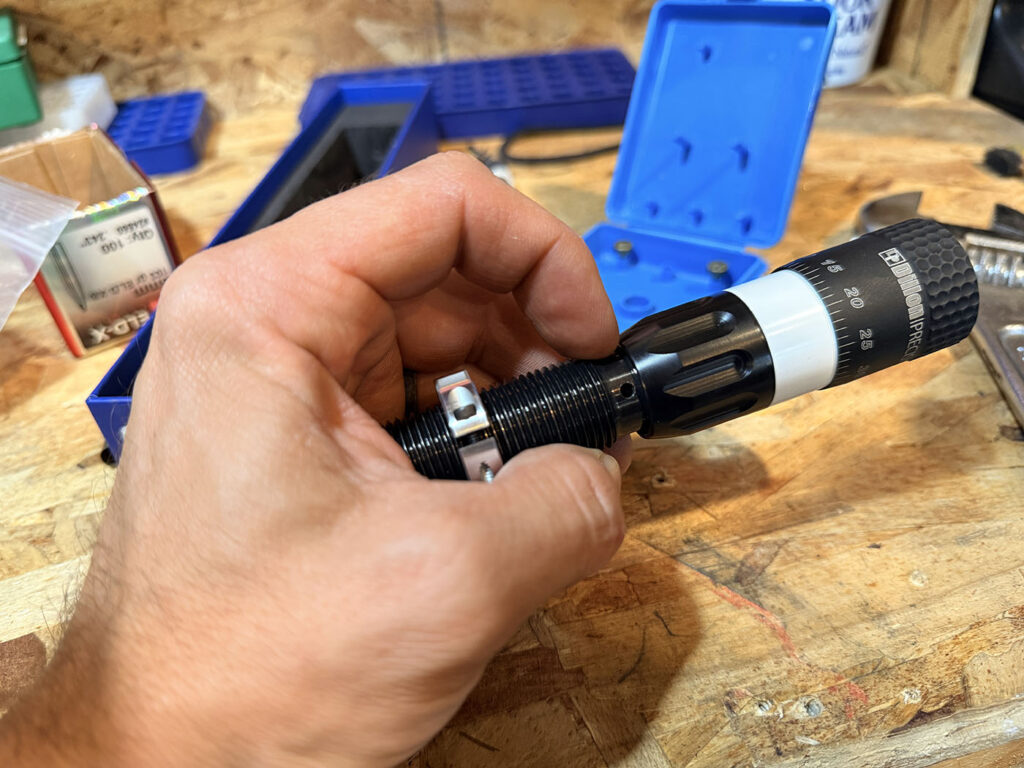
Let’s talk about finding the rifling in the throat of the chamber. I use a method of lightly pushing the cartridge up into the chamber and sticking the bullet into the lands. I then use a rod from the front and gently push against the bullet so I can feel if it is sticking or not. Seat the bullet deeper and repeat until it no longer hangs on the rifling. I wanted to put this micrometer to the test and moved it in two-click increments. I kid you not, trying it on two different cartridges, it was exactly the same on both to find the rifling. I would expect some slop, or the bullets to give a little more in one case or the other, but it was perfectly uniform. Rather than hope I was increasing the depth just enough to find the throat, it was so stinking easy. Once I had the loaded cartridge length to the lands, I just backed off the micrometer .020 of an inch/off the lands, and we were ready to roll with testing.
I chose a powder I had a bunch of. I tried Hodgdon Superformance with a CCI Small Rifle primer. It isn’t the normal powder choice for this cartridge, but I thought I would play with it and see if the gun liked it. I did a ladder test from 30-34 gr to find the pressure spike. It started to show in the brass flow around the primer at 33 gr, and the half-moon showed with the 34 gr load. I decided to back way off the pressure and tested 4 different loads from 31.0-31.9 gr. This covers the 3% of the charge weight most rifles have between harmonic accuracy nodes. I have had some custom loads work fantastically until I hit the hot days of prairie dog shooting and begin to over-pressure the cases in the heat. This is why I have started backing off instead of flirting with the edge of over-pressured loads in my hunting rifles.
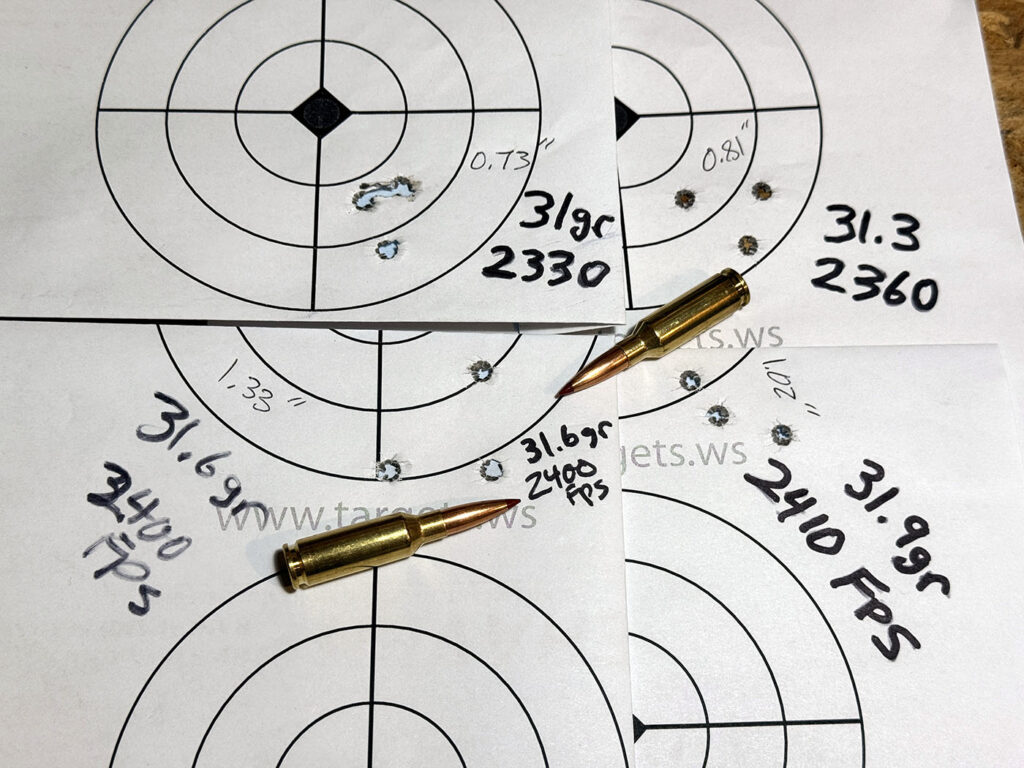
I tested three shots in each of the four different charge weights, increasing by 0.3 gr per group. You can see how the groups opened up as I went. So the closest loading to the node was the 31.0 gr loading. While I am thrilled with most any group under an inch, this 0.73” group is the tightest I have shot with this rifle. I’m sure it can do better, but I made it an ultralight and that generally isn’t conducive to the maximum accuracy a rifle can offer. The downside to using a powder no one else uses is that there is probably a reason. I was getting approximately 2,330 fps in these loads. That is 300 fps slower than the Hornady factory loading. I will probably redo these loading tests with a different powder until I can get a bit flatter trajectory.
Why do you need this Dillon Micrometer die? One, it will make your life easier. Two, it will save quite a bit of space as you can use it for multiple cartridges. Three, the average two-die set from several makers is somewhere between 35-100$. Most of these manufacturers offer the single sizing/decapping die for sale. It is usually 25-50% cheaper than the set of two when you need the bullet seater as well. This micrometer bullet seater can swap out the innards and load most or all .224, .243/6mm, .264/6.5mm, .284/7mm, .308, and .338 calibers with one die. It will be going on the .223 Remington toolhead next for a special loading project. Stay tuned!
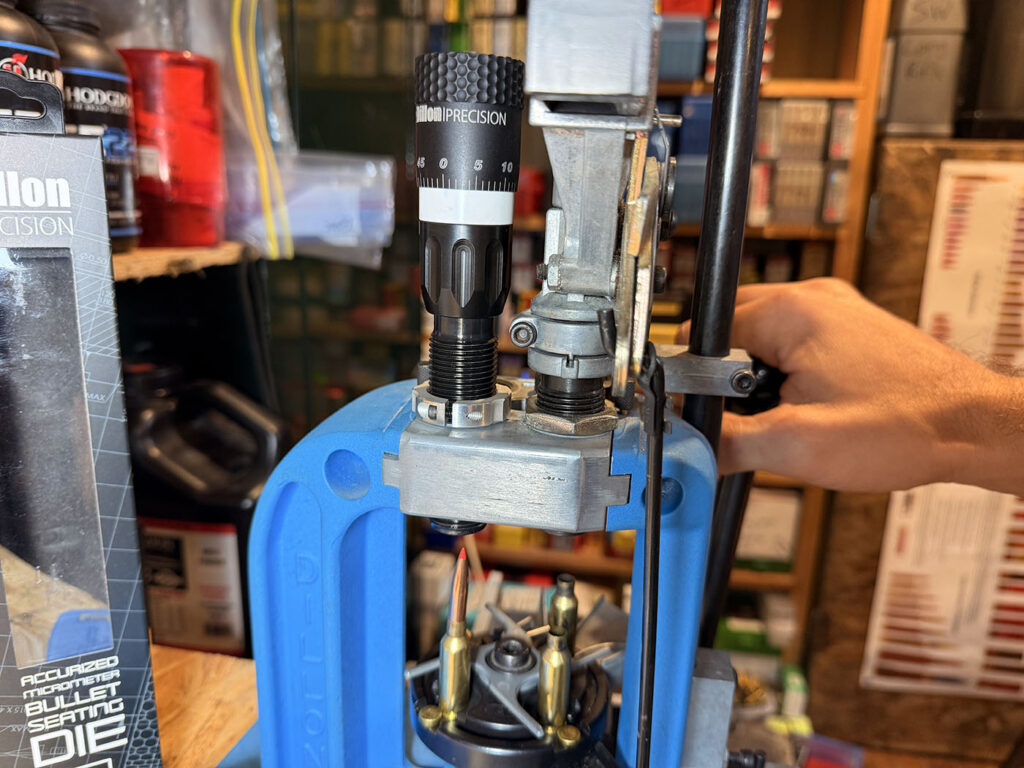
Here is what I am thinking. Why not spend less on excess dies and save the space, while spending a bit more on this die and its conversions for the ease and precision it offers? Suddenly, a line from The Lord of the Rings is popping into my head. “One” Dillon micrometer seating die “to rule them all!”
About the Author –
Dan is a native of Montana and the son of Skinner Sights owner, Andy Larsson. He loves the Lord, is a family man, and spends the time he can sharing the outdoors with others. Hunting is his main hobby, and reloading for that purpose has driven this passion.