
Why bullet design, aerodynamics, and ballistic coefficient matter to today’s handloaders.
If you’ve spent much time around reloaders, precision rifle shooters, or even hunters comparing ammunition, you’ve probably heard someone talking about ballistic coefficients. Usually, the conversation involves numbers like .450, .550, or even .700, followed by discussions about bullet drop, wind drift, and long-range accuracy.
For someone new to reloading, it can sound like a subject requiring an engineering degree.
Fortunately, understanding ballistic coefficient, commonly called BC, isn’t nearly as complicated as it sounds. More importantly, knowing what those numbers mean can help you make better decisions when selecting bullets for your favorite cartridges.
Whether you’re loading .223 Remington for a weekend at the range, .308 Winchester for hunting season, or 6.5 Creedmoor for long-range shooting, ballistic coefficient deserves some attention.
What Exactly Is Ballistic Coefficient?
In simple terms, ballistic coefficient describes how efficiently a bullet travels through the air compared with a standard reference projectile.
Think about throwing a baseball into a strong headwind compared with throwing a football. The football’s aerodynamic shape allows it to move through the air more efficiently. Although bullets are considerably more sophisticated, the basic principle is similar.
A bullet with a higher ballistic coefficient generally retains velocity better and experiences less wind drift than a lower-BC bullet launched at the same velocity under comparable conditions.
However, BC isn’t simply a measurement of how pointed a bullet looks.
Bullet weight, diameter, shape, and the way its drag changes through flight all contribute to ballistic performance.
One important distinction is that a higher BC doesn’t automatically mean a more accurate bullet. Accuracy depends on numerous factors, including the firearm, ammunition consistency, and bullet stability.
Understanding G1 and G7 Without Getting Confused
When shopping for rifle bullets, you’ll frequently encounter two different ballistic coefficient measurements: G1 and G7.
Both describe aerodynamic performance, but they use different reference projectile shapes.
The G1 model is based on an older, relatively blunt reference projectile. It has been used throughout the ammunition industry for decades and remains common in bullet manufacturers’ published specifications.
G7, on the other hand, uses a reference shape more representative of modern, streamlined, boat-tail rifle bullets.
For reloaders working with high-BC, long-range projectiles, G7 data can often provide more useful ballistic predictions.
Here’s the important part: G1 and G7 numbers cannot be compared directly.
A bullet advertised with a .600 G1 BC isn’t necessarily more aerodynamic than one listed with a .300 G7 BC. They’re measured against different reference standards.
When comparing bullets, make sure you’re comparing the same BC model.
Why Modern Reloaders Should Care
Years ago, many reloaders concentrated primarily on velocity and group size. Those remain important, but today’s bullet technology has introduced another dimension to ammunition selection.
Modern projectiles frequently incorporate polymer tips, secant or hybrid ogives, and boat-tail designs intended to improve aerodynamic efficiency.
Consider the popular .308 Winchester.
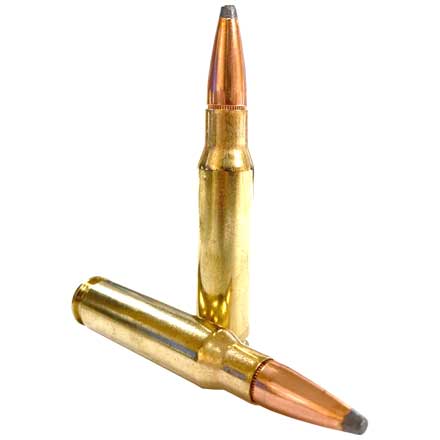
A traditional 150-grain hunting bullet can perform exceptionally well at conventional hunting distances. However, a heavier, streamlined match bullet may retain velocity more efficiently and resist wind drift better as distances increase.
The same principle applies to the .223 Remington.
A lightweight 55-grain bullet is an excellent choice for many recreational shooting applications. But shooters working at extended distances often consider heavier, higher-BC bullets, such as 69-, 75-, or 77-grain match projectiles.
There’s a catch, however.
Not every rifle can properly stabilize every bullet. Barrel twist rate, bullet length, and velocity all influence stability. Some longer .223 bullets may also exceed standard magazine-length limitations.
This is why bullet selection should begin with the firearm’s capabilities rather than simply choosing the highest BC printed on a box.
Popular Cartridges and Ballistic Coefficient
Let’s look at several cartridges commonly found on reloading benches today.
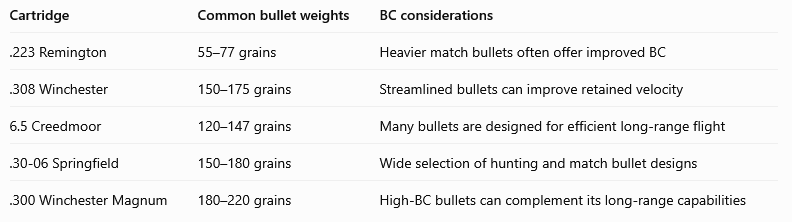
These are representative bullet-weight ranges, not specific load recommendations. Actual performance depends on the individual projectile and firearm.
Does Higher BC Mean Less Bullet Drop?
Generally speaking, a higher-BC bullet retains more velocity, which can reduce drop over longer distances when other relevant factors are equal.
However, there’s an important consideration.
A heavier, high-BC bullet may leave the barrel at a lower velocity than a lighter bullet. At shorter distances, that lighter projectile may actually have a flatter trajectory.
As distances increase, the more aerodynamic bullet may begin showing its advantages through better velocity retention.
Wind drift is another major consideration.
For long-range shooters, reduced wind drift can be more valuable than a modest improvement in trajectory. Even small differences in wind movement can become significant as shooting distances increase.
This is where modern ballistic calculators become particularly useful. Rather than guessing, reloaders can enter verified bullet information and measured muzzle velocity to develop more realistic trajectory estimates.
What About Handgun Reloading?
Ballistic coefficient isn’t exclusively a rifle consideration, although its importance is generally much greater at extended distances.
For someone reloading 9mm, .40 S&W, or .45 ACP for conventional handgun distances, bullet reliability, consistency, and appropriate terminal performance typically deserve more attention than BC.
Handgun bullets generally travel shorter distances and often have less aerodynamic shapes than modern rifle projectiles.
That doesn’t mean ballistic coefficient is irrelevant. It simply means its practical influence may be relatively small for the shooting distances involved.
For most handgun reloaders, chasing a higher BC probably isn’t going to produce a noticeable advantage.
Finding the Right Balance at the Reloading Bench
One of the things I’ve always appreciated about reloading is the ability to understand the individual components that make ammunition perform.
Ballistic coefficient is another piece of that puzzle.
But I wouldn’t recommend choosing a bullet based solely on its BC rating.
A high-BC projectile that doesn’t stabilize properly in your rifle isn’t going to deliver the performance you’re hoping for. Likewise, an exceptionally aerodynamic match bullet may not be the best choice for hunting if it lacks the appropriate terminal-performance characteristics.
Start by identifying your intended application. Consider the distances you’ll be shooting, your barrel’s twist rate, and the bullet manufacturer’s recommendations. Then select components using reliable, published reloading data.
Remember that changing bullet designs can change pressure characteristics, even when bullet weights are identical.
Ballistic coefficient doesn’t have to be intimidating. At its core, BC helps describe how efficiently a bullet moves through the air. Understanding that simple concept can make you a more informed reloader, particularly when working with modern rifle cartridges.
You don’t need to memorize complicated formulas or spend hours studying aerodynamic engineering.
You simply need to recognize that bullet design matters, velocity isn’t everything, and the highest number on the box isn’t always the best choice.
For today’s reloader, understanding ballistic coefficient isn’t about becoming a mathematician. It’s about making smarter component decisions and getting the most out of the ammunition you produce.
And that’s something every serious reloader can appreciate.