
Understanding Powder Burn Rates: How They Affect Accuracy and Velocity – by Jonathan Kilburn
When I first started reloading, I walked into a gun shop and asked for powder. That was pretty much the whole question. I needed powder. At that point, I did not understand that one powder might be intended for a small pistol cartridge while another was better suited to a large rifle case. Smokeless powder was smokeless powder in my mind. The guy behind the counter immediately started asking questions. What caliber? Rifle or pistol? What bullet was I loading? I remember thinking this was getting much more complicated than it needed to be.
Looking back now, those were exactly the questions he should have been asking. Powder is not simply powder. There are fast-burning propellants that work well in small handgun cases, medium-burning rifle powders that cover a wide range of cartridges, and slow-burning powders that make much more sense in large-capacity rifle cases with heavier bullets. There is overlap between those groups, but a bottle of pistol powder and a bottle of H1000 are solving very different problems.
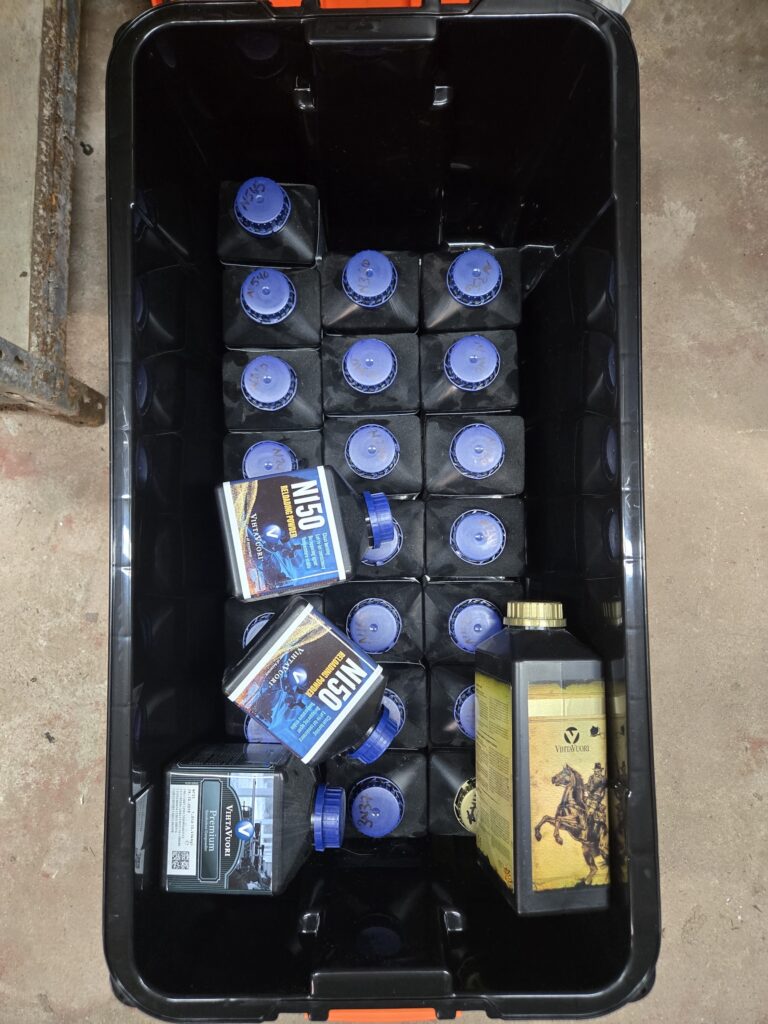
Eventually most reloaders find a burn-rate chart. The powders are lined up from fast to slow and suddenly everything seems organized. H4198 is relatively fast for a rifle powder. Varget sits farther into the medium range. H4350 is slower, and H1000 moves farther into the slow rifle powders. That chart is useful, but only if we understand what it is actually showing us.
A burn-rate chart is not load data. It is not a substitution chart either. Two powders can sit close together and still have different densities, grain shapes, chemical compositions, pressure characteristics, and charge requirements. If one powder becomes unavailable, the chart can point toward another powder worth researching. It does not mean you use the same charge because the names are neighbors on a piece of paper. There are plenty of good ways to experiment with reloading. Guessing with powder is not one of them.
Pressure Is the Real Story
Burn rate makes more sense when you stop thinking about fire and start thinking about pressure. When the primer ignites the powder, gas is produced and pressure begins rising inside the case. Eventually enough force acts against the base of the bullet to start it moving. From that moment forward, the internal volume is increasing as the bullet travels down the bore, powder is still burning, and pressure is still changing.
A faster-burning powder generally develops more of its useful pressure earlier in that event. A slower-burning powder generally spreads gas production over a longer portion of the bullet’s travel. The powder still has to match the cartridge and bullet. Slow is not automatically better, and fast is not automatically better. We are simply trying to create the right pressure behavior for the job.
H4198, Varget, H4350, and H1000 make a good example. All four are rifle powders, but they occupy very different parts of the burn-rate spectrum. H1000 is not a better powder because it is slower than Varget. H4198 is not somehow less capable because it burns faster. A half-inch wrench is not worse than a one-inch wrench. You just need the correct one for what you are trying to turn.
Case capacity and bullet weight are a big part of that decision. A .223 Remington with a light varmint bullet creates a different internal environment than a .300 Winchester Magnum with a heavy projectile. The amount of powder space is different, bullet resistance is different, and the amount of barrel available for the expanding gas to work through can be different. That is why the useful powder range changes as the cartridge and bullet change.
One Cartridge Can Use Several Burn Rates
The .223 Remington is a good example because published data can include powders such as H4198, H322, Benchmark, H335, CFE 223, Varget, and others depending on bullet weight and application. Those powders do not all sit in the exact same place on a burn-rate chart, but they can all have useful applications in the same cartridge.
That should tell us there is no single “.223 powder.”
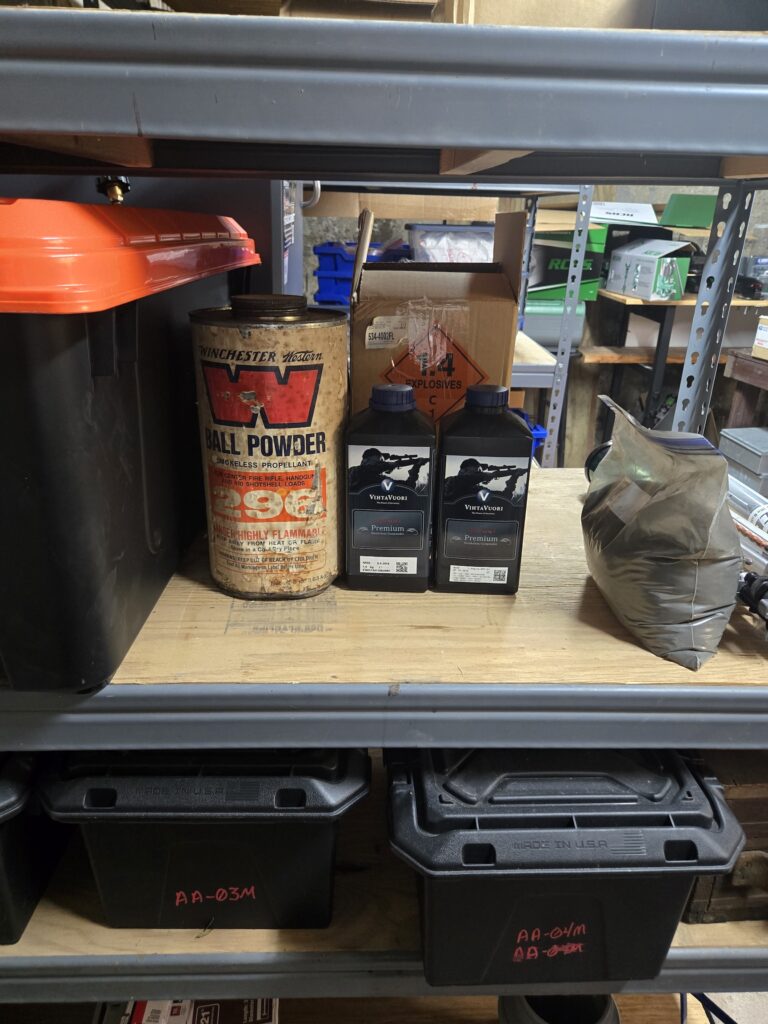
A light bullet and a heavier projectile are not the same load simply because they use the same case. Change bullet weight and you change how the load behaves. A powder that works extremely well with one bullet may not be the first choice with another.
Move into .308 Winchester and medium-burning rifle powders such as Varget, IMR 4064, Reloder 15, and CFE 223 become familiar names. Again, they are not identical. CFE 223 is spherical while Varget and IMR 4064 are extruded. That changes how they meter, how much case volume they occupy, and how they behave on the loading bench before we even fire a round.
Good metering is nice. It does not make a powder automatically accurate. Anyone who has fought long extruded kernels through a powder measure can appreciate a smooth-flowing spherical powder, but the target still gets to decide whether all that convenience was worth anything.
Bigger Cases, Slower Powders
As bullet weight and case capacity increase, slower-burning powders often begin making more sense. Powders in the H4350 range are a good example. H4350, Reloder 16, and StaBALL 6.5 all live in roughly the same part of the burn-rate spectrum, even though they are different products with different physical characteristics.
H4350 became closely associated with cartridges such as the 6.5 Creedmoor because that general burn-rate range works very well with many of the heavier bullets commonly used in the cartridge. That does not mean H4350 is the only powder that works, and it certainly does not mean every Creedmoor rifle will shoot its best groups with it. The combination simply makes mechanical sense.
Move farther into large rifle cases and powders such as H4831SC, H1000, Reloder 22, Reloder 26, N560, N565, and N570 start appearing more often. A .300 Winchester Magnum can make productive use of slower-burning powders because it has the case capacity and bullet weight to use that longer pressure curve.
The mistake is thinking slower always means more velocity. It does not. Eventually you can go too slow for the cartridge and bullet combination. The case only has so much room, and the barrel only gives the expanding gas so much distance to work. At some point, moving farther down the chart just means you picked the wrong powder more confidently.
Velocity Is Not Free
Slower powders can sometimes produce more velocity than faster powders in the same cartridge because they can maintain useful pressure farther down the bore. If the cartridge and bullet can make use of that pressure, the bullet continues accelerating over a greater distance.
That does not mean maximum velocity should always be the goal.
Chronographs make it very easy to become obsessed with numbers. I like velocity as much as anyone, but another 40 feet per second is not automatically an improvement. If one load produces slightly more speed while another produces tighter groups and more consistent performance in the rifle, I am probably taking the slower load home.
I would rather hit what I am aiming at than miss it faster.
Powder density also plays into this. Different powders occupy different amounts of space for the same weight. A spherical powder may pack tightly while an extruded powder takes up more volume. Case fill can affect how practical a powder is in a particular load and may influence ignition consistency as well. Burn rate is only part of the decision.
Burn Rate and Accuracy
Burn rate can affect accuracy, but it does not create accuracy by itself. Powder selection influences ignition, pressure development, velocity, case fill, and barrel time. All of those can contribute to how well a rifle shoots, but there is no magic point on the burn-rate chart marked “small groups.”
Two powders can produce nearly identical velocity and still shoot very differently. One might give lower extreme spread while another prints smaller groups. This is where chronograph data can be both useful and distracting.
A single-digit standard deviation looks great.
If the rifle still shoots poorly, you have very consistent ammunition the rifle does not like.
That is still useful information, but I am not framing the chronograph numbers and hanging them over the target.
The target matters. The rifle matters. The intended use matters. A hunting load, a long-range competition load, and casual practice ammunition do not all need the exact same characteristics. Powder burn rate helps narrow the choices, but actual testing tells us which combination works.
Barrel Length Does Not Fix Everything
Barrel length gets pulled into burn-rate conversations constantly. A common statement is that short barrels need fast powder because slow powder will still be burning when the bullet exits.
That is too simple.
Powder does not have to be completely consumed before the bullet leaves the barrel to contribute to acceleration. What matters is the pressure acting against the base of the bullet. A longer barrel gives that pressure more distance to work. A shorter barrel gives it less.
Changing barrel length can change which powder produces the best result, but it does not create a rule where shorter automatically means faster powder. Muzzle flash does not solve the mystery either. A large fireball tells you there is hot gas and possibly burning material leaving the muzzle. It does not provide a pressure trace.
Actual testing still wins.
Powder Is Not Just Powder
I understand now why the guy at the gun shop did not just grab the nearest bottle and ring me up. He needed to know what I was loading because the powder had to fit the cartridge, bullet, and firearm.
That is still how I approach powder selection today.
Start with published data. Look at what powders are listed with the bullet weight being used. Compare where they sit on the burn-rate chart. Think about case fill, desired velocity, barrel length, and the intended use of the ammunition. Then test.
Maybe the rifle likes Varget.
Maybe it prefers H4350.
Maybe the powder you thought would be perfect ends up being mediocre.
The rifle does not care what you wanted to work.
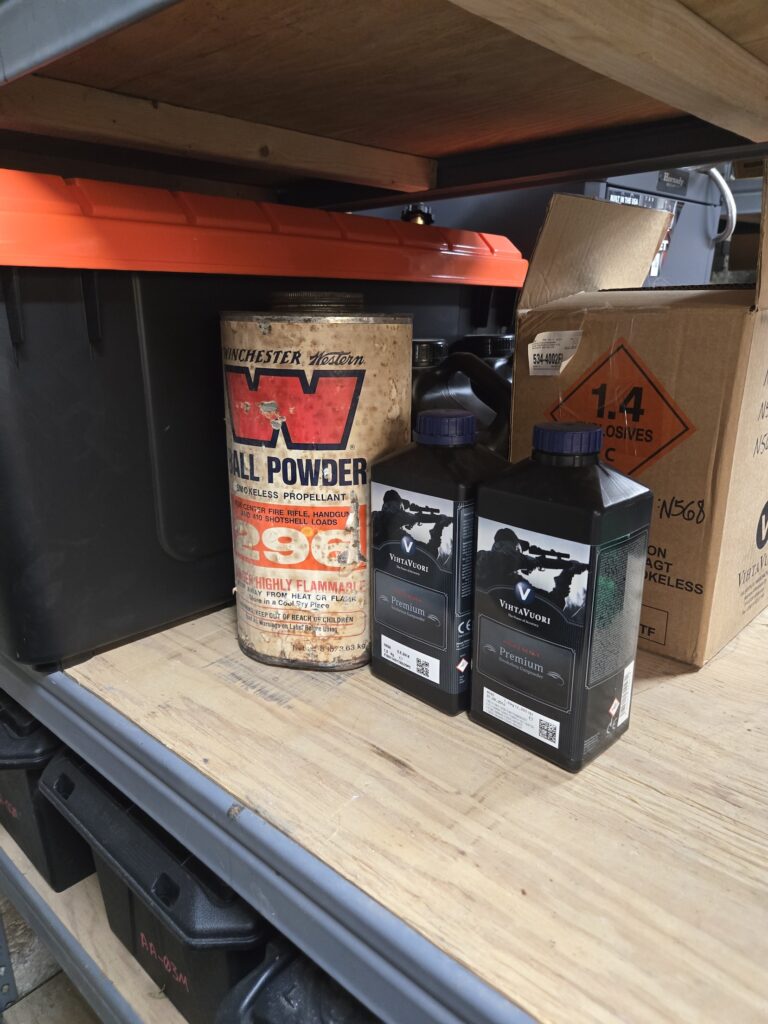
A burn-rate chart helps us understand why H4198, Varget, H4350, and H1000 can all be excellent powders while doing very different jobs. It can help us understand why bullet weight changes powder selection and why larger cases can often make better use of slower propellants.
What it cannot do is choose the load for us.
I walked into that shop years ago thinking powder was powder. I was technically correct in about the least useful way possible.
There was a lot more to the question than I knew to ask.
There usually is in reloading.