
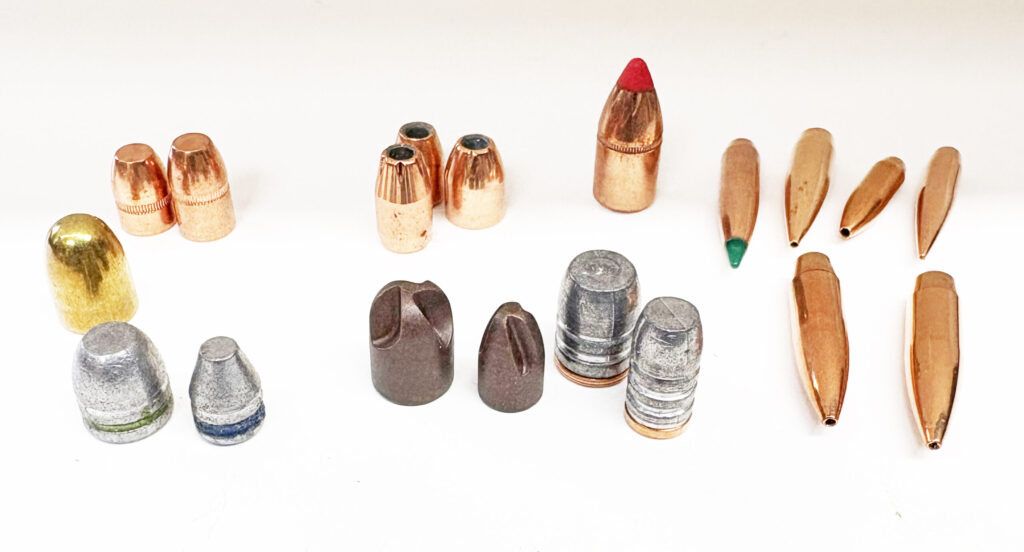
Bullet shapes are engineered to balance three primary factors: aerodynamics, feeding reliability and terminal performance. Each design choice affects how a bullet flies through the air, how reliably it chambers and fires and how it behaves when it strikes a target. This overview is intended for shooters, hunters and handloaders who want a practical understanding of how bullet geometry, materials and construction influence real-world performance.
- Bullet Nose (Meplat) Designs
The front end of a bullet, known as the meplat, plays a major role in aerodynamic drag and impact behavior. Common nose designs include the following: - Spitzer (Pointed)
The standard profile for most modern rifle cartridges. Its pointed shape minimizes drag resulting in flatter trajectories, higher retained velocity and improved long-range performance. - Hollow Point (HP)
Features a cavity in the tip designed to promote rapid expansion upon impact. As the bullet expands, it transfers energy efficiently to the target and reduces the likelihood of complete passthrough. Expansion typically produces a mushroom shaped profile. - Round Nose (RN)
A traditional design commonly used for short-range hunting and in older firearm platforms. While less aerodynamic than pointed bullets, round-nose designs often feed reliably and are well-uited to moderate velocities. - Flat Nose (FN)
Frequently used in lever-action rifles with tubular magazines. The flat tip helps prevent accidental primer detonation from recoil by eliminating a pointed contact surface between cartridges. - Wadcutter (WC)
A cylindrical, flat-faced bullet primarily used in target shooting. Wadcutters cut clean, precise holes in paper targets making scoring easier. - SemiWadcutter (SWC)
A hybrid design featuring a flat nose with a tapered body. This provides better aerodynamic performance than a full wadcutter while retaining clean target impact characteristics. - Ballistic Tip / Polymer Tip
A hollowpoint bullet fitted with a polymer insert. The tip improves ballistic efficiency while acting as a wedge to initiate controlled expansion on impact. - Truncated Cone (TC)
A coneshaped bullet with a flat tip. Popular in target shooting, it offers a balance of improved aerodynamics and reliable, clean target perforation. - Open Tip Match (OTM)
Often mistaken for hollow points, OTM bullets feature a small opening at the tip that results from the manufacturing process. This design helps ensure precise weight distribution for enhanced long-range accuracy rather than expansion.
Specialized Nose Designs: Fluted and External Hollow Point Bullets
Fluted bullets represent a modern departure from traditional expansion based designs. Rather than mushrooming on impact, these bullets use machined flutes in the nose to redirect fluid laterally upon entering soft tissue. This fluid displacement creates a large permanent wound cavity while the bullet itself remains structurally intact.
Fluted bullets are typically CNC machined from solid copper or copper polymer blends. Because they do not rely on expansion, they are less susceptible to clogging when passing through heavy clothing or intermediate barriers. The flutes harness the bullet’s rotational energy to project fluid outward producing tissue disruption without a change in bullet shape. Their lighter construction often allows for higher velocities and reduced recoil compared to traditional lead-core bullets of similar caliber.
These designs are particularly effective when barrier penetration and consistent terminal performance are required such as when encountering auto glass, sheet metal or bone.
Popular examples include:
- Lehigh Defense Xtreme Penetrator (optimized for deep penetration)
- Lehigh Defense Xtreme Defense (optimized for enhanced tissue disruption)
- Inceptor ARX (uses a three flute copper polymer design)
- Black Hills HoneyBadger (incorporates Lehigh’s fluted technology)
- G9 External Hollow Point (EHP) (uses aggressive external fluting to create highpressure fluid displacement in soft tissue)
Bullet Base (Rear) Designs
The shape of the bullet’s base affects stability, gas seal efficiency and aerodynamic drag.
- Flat Base
The most common base design for short to medium range shooting. Flat bases provide a strong surface for propellant gases and often deliver excellent accuracy at distances under approximately 300 yards. - Boat Tail (BT)
A tapered base that reduces turbulence and base drag. Boat-tail bullets are generally preferred for long-range shooting due to improved ballistic efficiency and reduced wind drift. - Hollow Base
Used primarily in some handgun bullets, hollow bases help the bullet expand slightly to engage the rifling more effectively improving stability at lower pressures.
Bullet Materials
Modern bullets are most commonly made from a lead core encased in a harder copper jacket, though material selection varies based on intended use.
Common Metals
- Lead
Valued for its high density and malleability. Lead is often alloyed with antimony or tin to increase hardness for higher velocities. - Copper and Copper Alloys
Used primarily for bullet jackets or for solid monolithic bullets. Gilding metal, typically 95% copper and 5% zinc, is commonly used for jackets. - Brass
A harder copperzinc alloy often used in solid bullets designed for deep penetration and high weight retention. - Steel
Occasionally used as a core material or penetrator in specialized ammunition designed to defeat hard barriers.
Specialized and NonMetallic Materials
Tungsten and Depleted Uranium
Extremely dense materials used in specialized military armor-piercing projectiles.
Plastics and Polymers
- Polymer tips improve ballistic efficiency and assist with controlled expansion.
- Nylon coatings, such as those used in coated lead bullets, reduce barrel fouling and friction.
Rubber and Wax
Used primarily in less-lethal or specialized training ammunition.
Bismuth and Tin
Nontoxic alternatives to lead commonly used where environmental regulations restrict lead ammunition.
Bullet Construction Types
Full Metal Jacket (FMJ)
A lead core fully or nearly fully enclosed by a copper jacket designed to maintain shape and maximize penetration.
Jacketed Hollow Point (JHP)
A lead core with a jacketed hollow cavity engineered to expand upon impact and increase energy transfer.
Solid / Monolithic
Constructed entirely from a single metal such as copper or brass. These bullets are known for excellent weight retention and penetration.
Frangible
Made from compressed powdered metals that disintegrate upon striking hard surfaces reducing the risk of ricochet.
Conclusion
Bullet shape, base design, material selection and construction all play critical roles in determining how a projectile performs in flight and on impact. For hunters and recreational shooters, selecting an appropriate bullet is often straightforward once the intended use is defined. For handloaders, however, understanding these variables is essential. Informed bullet selection directly influences feeding reliability, accuracy, penetration and terminal behavior making it a fundamental component of consistent and predictable performance.